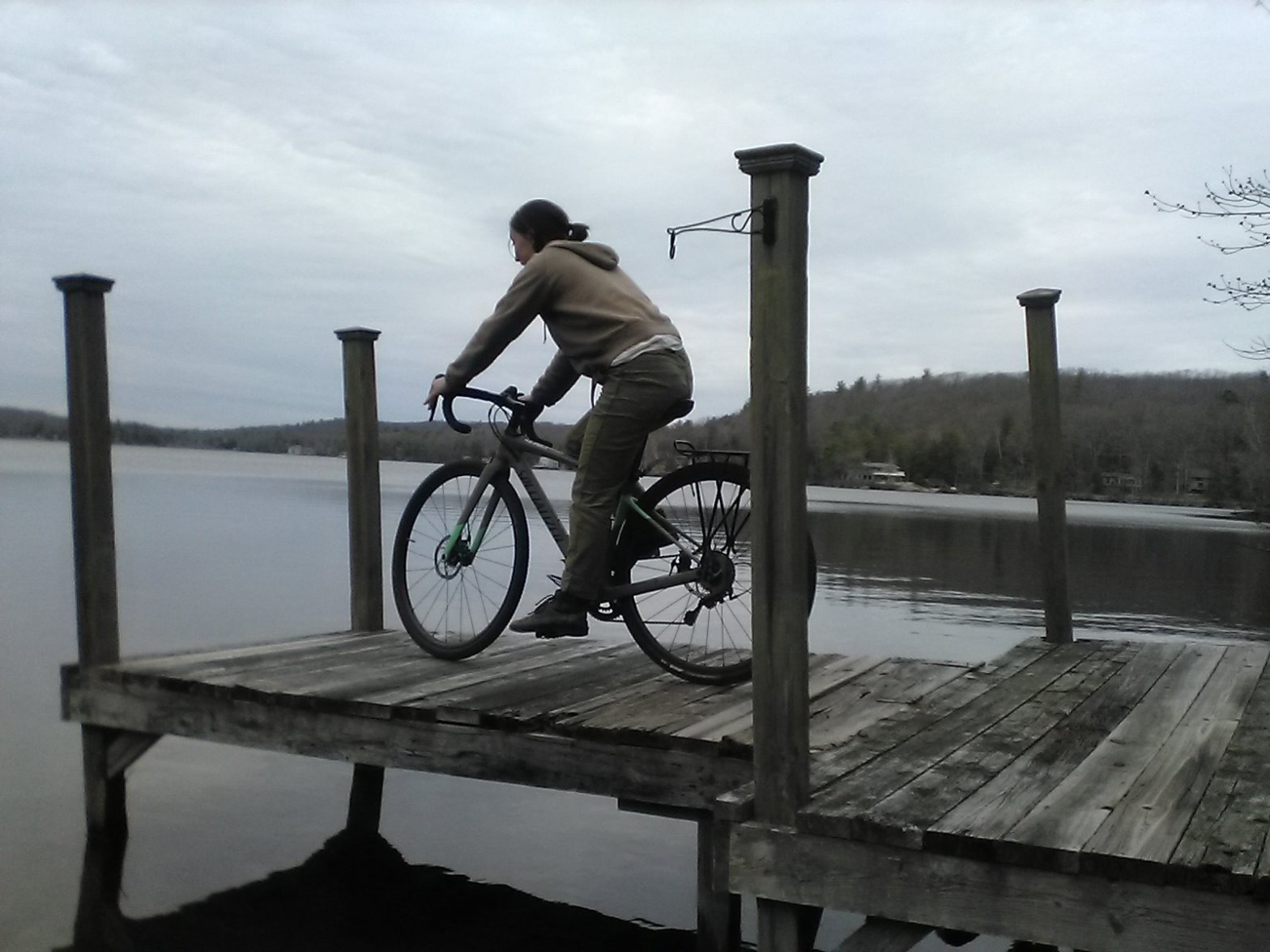
The picture was taken by my brother Morgan, of me on a dock at lake Skatutakee in Harrisville NH.
I remember first learning to bike on the little red hand-me-down two wheeler that my brothers had learned on. I remember getting my first real bike, that my mom found on the side of the road, and after that the purple one from some friends. That one lasted a while. There have been many more bikes in my life, and many, many hours spent on each one. First it was with all the neighborhood kids with our homemade jumps and games of Chicken in the parking lot. Then longer bike rides with family, or on camping trips with friends. Then commuting to school, highschool, and jobs, and then college. These memories stand out for me because the time spent on a bike is beautiful. I can’t help but smile when I’m on my bike. You see the world differently from a bike. It wakes you up while slowing you down. It makes you strong. It can take you places a car can’t go, without disturbing the quiet or wildlife. It doesn’t require fossil fuels, or pollute our air. It is free, accessible to anyone, but building support, and infrastructure for bicycles in our cities and towns, benefits more than just the serious bike fanatic. It benefits everyone in the community.
Building bike infrastructure means building more bike lanes on our roads. It means maintaining and building good bike paths with lights. It means putting in more bike racks, and making bikes available to more people, through donation programs or city paid programs. It means more businesses having showers at work, to support those who bike and making it more achievable for people who don’t. It means building these things and building support for these things to increase the number of people biking, and decrease monetary costs, environmental, and health costs. According to Drawdown.org, bicycle trips will rise to 3-8 percent of urban trips made, from the current less than 3 percent. This projected increase would displace conventional transportation trips, and avoid 2.6–6.6 gigatons of CO2 emissions. Not only do bikes themselves not burn fossil fuels, but the production of bikes is smaller scale than cars, they require less maintenance, do less damage to roads and take up less space. All things that save energy use compared to conventional transportation methods.
The health impacts of riding a bike are clear as well. Breathing fresh air, building muscle, and strengthening your cardiovascular health, are some of the easily seen benefits. According to exerciseismedicine.org, Regular physical activity can reduce risk of diabetes, dementia, depression, high blood pressure, etc., by 40 percent. (https://www.exerciseismedicine.org/assets/page_documents/EIMFactSheet_2014.pdf) The more people are biking, the less trips to the doctor are being made, and the whole community saves money on healthcare costs. QBP, a bike company in Minneapolis, started to give incentives to employees to bike to work, and they found a 4.4% reduction in healthcare cost in just 2 years, or $200,000 in savings. (StreetsBlog.org) Just as with the decrease in CO2 emissions and healthcare costs, the increase in safety when there is strong bike infrastructure, benefits everyone on the road. Having bike lanes keeps bikes out of drivers’ way, making it safer for them, as well as bikes off the sidewalk, making it safer for pedestrians (aarp.org).
Another benefit to an increase in bike infrastructure, is the equalizing of economic positions and stereotypes that go with them. As biking becomes more supported by the businesses and the city, people of all economic status will be biking. In addition, building bike infrastructure, specifically support from businesses, will make biking to work a good option for those who can’t afford to drive.
All of the previously mentioned benefits are reason enough to put our money and support toward building bike infrastructure, and the short term costs of doing so make it even more achievable. When comparing the costs of building light traffic roads, and building bike lanes, the initial costs of the latter saves $2.7 trillion, with a lifetime savings of $827 billion. (Drawdown).
We now find ourselves in a time where much has changed, people are driving less due to COVID-19, and the economy is struggling. Since people are already changing fundamental things about their lives, this may mean it is the perfect time to implement inexpensive alternatives that benefit the health and well-being of our society.
Finally, I’d like to invite us all to push ourselves to use a bicycle to commute, when we may have previously used a car. I personally am always glad I did so. I also believe that one of the ways we can support the building of bike infrastructure is simply by riding our bikes more. The more bikes there are on the road, the more policy makers, businesses, and city officials will see biking as an attainable, sustainable alternative, that they should support.
Sources
Bicycle Infrastructure @ProjectDrawdown #ClimateSolutions. (2020, February 25). Retrieved from https://www.drawdown.org/solutions/bicycle-infrastructure
Dean, C. (2009, January 12). A Bicycle Evangelist With the Wind Now at His Back. Retrieved from https://www.nytimes.com/2009/01/13/science/earth/13profile.html?searchResultPosition=7
Walljasper, J. (n.d.). How Bicycling Infrastructure Benefits Non-Bicyclists. Retrieved from https://www.aarp.org/livable-communities/getting-around/info-2016/why-bicycling-infrastructure-is-good-for-people-who-dont-ride-bikes.html
 pondering sustainability